|
Towards the Theory
of Transformational and Transactional Neuroleadership
Adel Tajasom and Zainal Ariffin Ahmad © 2009
Our research focuses on expanding neuroleadership into Transformational
and Transactional Neuroleadership. As a new field of study, neuroleadership
offer insights into leadership behaviours from the lens of neuroscience.
Similar to neuroeconomics which draw from experimental economics and
psychology, neuroleadership draws from leadership, neuroscience and
psychology and looks at elements of leadership such as awareness of
self, awareness of others, insight, influence and decision making. The
common focus area of research is decision making which has been studied
extensively from the economic standpoint, but not from leader’s behavior
or style. In our study, we explore the cognitive aspect of decision
making and unravel the process involving the human brain. As leadership
theories cannot explain the leader’s behaviour in decision making, we
look to neuroscience to understand this phenomenon. In this aspect we
use neuroimaging (EEG) to identify the specialized regions in the brain
related to decision making and to find out how managers make decision
given their leadership style (transformational/transactional). The methodological
and ethical issues will also be discussed.
Key words: Decision Making, Neuroleadership, Leadership Behaviour, Leadership
Style, Transformational Leadership, EEG
Paper to be presented at the International Annual Seminar and Workshop,
Kyoto Sangyo University, Kyoto 27th -28th March 2009.
Transactional vs Transformational Neuroleadership
- Bass: Transactional and Transformational dimensions are separate.
- Burns: Transactional and Transformational are opposite ends of the
leadership continuum.
Decision Making
& Neuroleadership
Whereas decision making has been studied extensively from the economics
standpoint, not so from leadership behavior or style.
- Whereas leadership theories cannot explain the leader’s behavior of
decision making, we explore the neuroscientific aspects of decision
making, i.e. from the neuroleadership perspective.
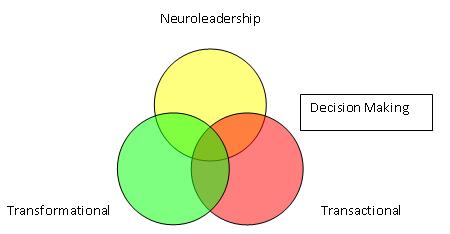
- Therefore, we extend Bass’ work on Transactional and Transformational
Leadership intoTransactional and Transformational Neuroleadership.
Transformational
Neuroleadership
For transformational leaders, decision making is based on cognitive
rewards.
They provide a climate of trust and draw out the followers’ higher order
needs to perform beyond expectations.
Transformational leaders inspire their followers to make decision that
transcend self-interests.
This is counter to the Classical Decision Theory (CDT).
Transactional
Neuroleadership
For transactional leaders, decision making is based on contingent rewards.
They clarify the options and outcomes for the followers to maximize
gains or benefits to perform meeting expectations.
Transactional leaders interact with their followers to make decision
to suit self-interests.
This is in line with the Classical Decision Theory (CDT).
|
Transformational
|
Neuroleadership
|
Transactional
|
|
Idealized Influence
|
Influence
|
Management-by-exception
|
|
Inspiration
|
Insight
|
Laissez-faire
|
|
Intellectual Stimulation
|
Self
Awareness
|
Contingent Reward
|
|
Individualized Consideration
|
Awareness of Others
|
|
Decision Making
|
|

 Home
Home