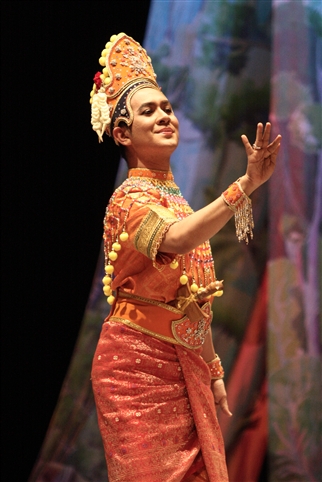

To this day, there are no accurate answer to explain the origin or the history on the beginning of the Makyung theatre. There have been a few theories that has been forwarded to explain the origin of Makyung.
One of the more trusted theory states that the Makyung performance originated during the 16th century and was the only form of entertainment well-liked by the rulers in Pattani – in south Thailand which is the present day state of Kelantan in Malaysia. It was believed that its birth originated during the rule of four Pattani rulers; namely Raja Hijau, Raja Biru, Raja Ungu and Raja Kuning who ruled between 1585 and 1680. The character of the king in the Makyung stories which was played by women is also believed to be an honour or a reflection of the kingdom of Patani which was ruled by women at that time.
It should be emphasized here, when one view the decorative head ('head gear') of Pak Yong character and through the performance photos of Makyung from private collections and the collections of the National Archives, all the players of Pak Yong consistently wear the head gear of "the same shape”. From the view of the physical 'head gear' it can be deduced that it bears an influence from Siam (Patani). According to Zubaidah Sual, a specialist in Malaysian traditional costume, the Makyung’s ‘head gear’ has a very close relationship with the 'head gear' used in Menora performances. The emergence of Makyung from the Pattani Malay Kingdom is validated when viewed from the aspect of history, musical instruments, decorative head gear, language, costumes, movements and dances.